TMJ Disorders After a Car Accident
Temporomandibular joint dysfunction from collision forces causes jaw pain, clicking, locking, and limited mouth opening. TMJ disorders frequently co-occur with whiplash and are among the most overlooked injuries in personal injury evaluations.
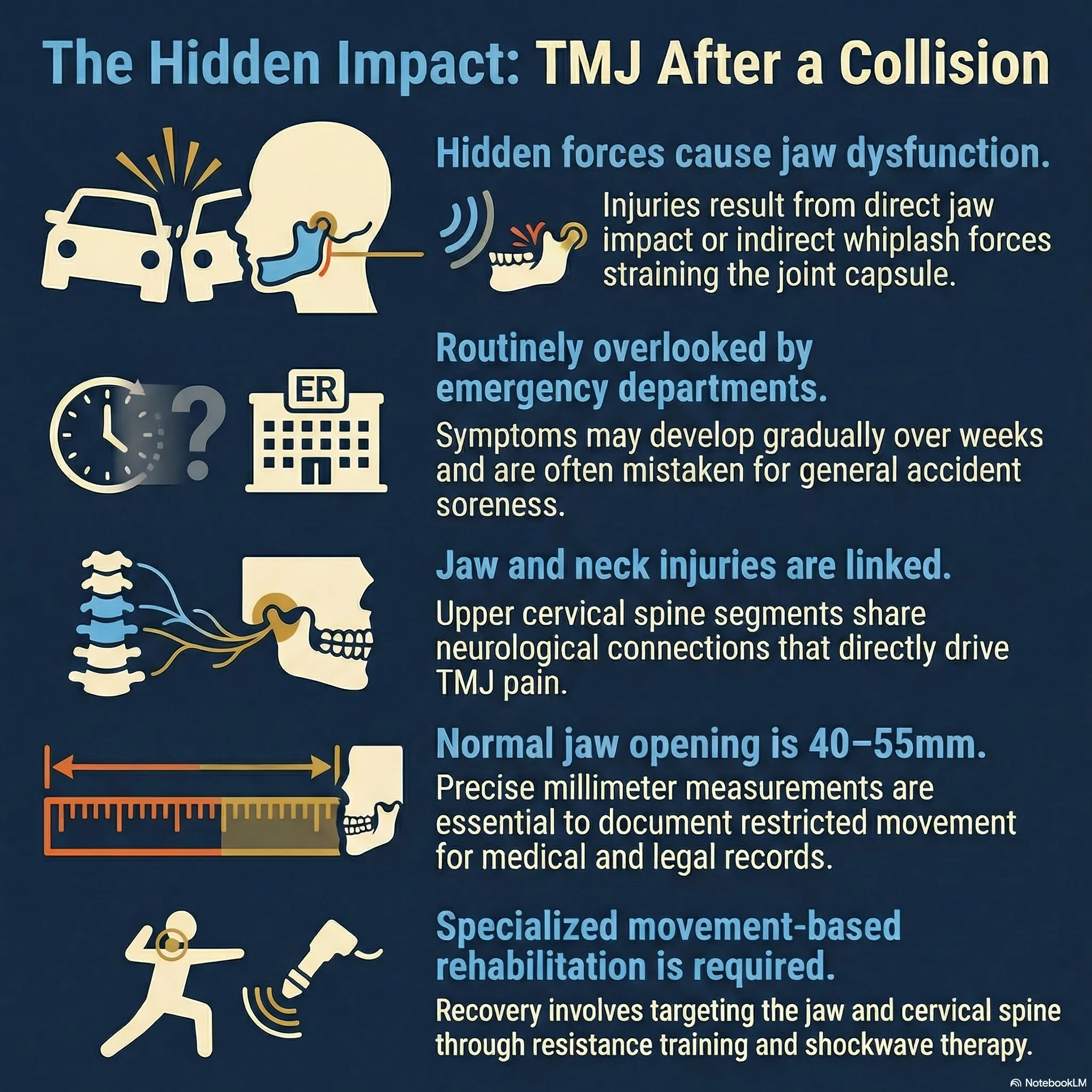
How It Happens in a Collision
TMJ dysfunction results from two mechanisms: direct impact to the jaw against the steering wheel, dashboard, or airbag, and indirect injury from cervical acceleration-deceleration forces that transmit through the mandible and strain the temporomandibular joint capsule and disc.
Daily Impact of TMJ
TMJ disorders affect fundamental daily activities. Patients experience pain while eating, difficulty speaking for extended periods, jaw clenching during sleep, and chronic facial pain. The condition can severely diminish quality of life and ability to work.
Frequently Overlooked
Emergency departments and initial treating physicians routinely miss TMJ injuries because they focus on more obvious structural damage. Symptoms may develop gradually over days or weeks after the collision, and patients often attribute jaw pain to general accident soreness.
Diagnosis
How we diagnose TMJ disorders
A thorough evaluation of the temporomandibular joint, cervical spine, and associated musculature to identify the source and severity of dysfunction.
Range of Motion Assessment
We measure maximum mouth opening, lateral excursion, and protrusion using precise millimeter measurements. Normal opening ranges from 40-55mm. Reduced range with deviation patterns indicates specific disc or muscular involvement.
Joint Auscultation
Palpation and auscultation of the TMJ during active jaw movements identifies clicking, popping, and crepitus. The timing and quality of joint sounds help differentiate disc displacement with reduction from degenerative joint changes.
Masticatory Muscle Palpation
Systematic palpation of the masseter, temporalis, medial and lateral pterygoid muscles identifies trigger points, spasm, and tenderness. Intraoral examination of the lateral pterygoid is essential for identifying the muscle most commonly injured in TMJ trauma.
Cervical Correlation
Because TMJ disorders frequently co-occur with whiplash, we evaluate the cervical spine simultaneously. The upper cervical segments (C0-C3) share neurological connections with the trigeminal nerve that innervates the TMJ, making concurrent assessment essential.
Cranial Nerve Assessment
Trigeminal nerve (CN V) motor and sensory testing evaluates the primary nerve supply to the TMJ and masticatory muscles. Mandibular branch dysfunction can produce altered sensation, weakened bite force, and referred pain patterns throughout the face.
Functional Impact Documentation
We document the functional impact of TMJ dysfunction on eating, speaking, sleep quality, and work capacity using validated outcome measures. This quantifiable data demonstrates the real-world consequences of injury for your case.
Treatment
How we treat TMJ disorders
A comprehensive rehabilitation program addressing both the temporomandibular joint and associated cervical spine dysfunction.
Progressive Resistance Training
Targeted exercises for the jaw and cervical spine strengthen weakened musculature and restore proper biomechanics. Jaw opening exercises against controlled resistance retrain coordinated mandibular movement patterns disrupted by injury.
Functional Resistance RehabilitationVibration Therapy
Whole-body vibration platform work addresses the cervical and postural components of TMJ dysfunction. By restoring proprioceptive accuracy in the cervical spine, we improve the head-neck positioning that directly influences jaw mechanics and joint loading.
Neuromuscular Activation PlatformFocused Shockwave Therapy
Acoustic energy applied to the masseter, temporalis, and periarticular tissues reduces chronic myofascial tension and stimulates healing in the TMJ capsule. Shockwave therapy addresses the tissue-level inflammation that perpetuates TMJ dysfunction.
Advanced Tissue RecoveryChiropractic Adjustments
Manual therapy targets the upper cervical spine and associated musculature that directly influence TMJ function. Restoration of proper C0-C3 segmental motion reduces the mechanical and neurological drivers of jaw dysfunction. Specific soft tissue techniques address the masticatory muscles and TMJ capsular restrictions.
- ✓ Upper cervical spine adjustment (C0-C3)
- ✓ Intraoral pterygoid muscle release
- ✓ Masticatory muscle myofascial therapy
- ✓ TMJ capsular mobilization techniques
- ✓ Measurable outcomes documented every visit
Our Difference
What makes us different
TMJ disorders are frequently underdiagnosed in personal injury cases. Our approach ensures nothing gets missed.
QME Designation
As a Qualified Medical Evaluator, Dr. Lloyd provides impairment ratings for TMJ dysfunction that are recognized by insurance carriers and courts. His understanding of the relationship between cervical injury and TMJ dysfunction strengthens causation opinions.
Defensible Documentation
TMJ findings are documented with millimeter-precise measurements, standardized muscle grading, and validated functional outcome scores. Reports detail the mechanism linking collision forces to TMJ dysfunction, providing the causal chain your personal injury attorney needs.
Movement-Based Approach
We address TMJ dysfunction as a whole-system problem, not an isolated jaw issue. By treating the cervical spine, posture, and masticatory system together, our progressive rehabilitation program produces lasting functional improvement that passive care alone cannot achieve.
Common Questions
Frequently Asked Questions About TMJ After a Car Accident
How does a car accident cause TMJ problems?
The sudden impact of a car accident — especially airbag deployment or a direct blow to the chin or side of the face — can cause a concussion or damage the temporomandibular joint, its disc, or the surrounding muscles. Even without direct facial contact, the rapid acceleration-deceleration forces of whiplash can strain the jaw muscles and ligaments, leading to TMJ dysfunction.
What are the symptoms of TMJ disorder after a car accident?
TMJ symptoms include jaw pain or tenderness, difficulty opening the mouth fully, clicking or popping sounds when chewing, jaw locking in the open or closed position, ear pain, headaches concentrated around the temples, and pain that worsens with chewing or yawning. Symptoms may appear immediately or develop over days to weeks after the accident.
Can a chiropractor treat TMJ from a car accident?
Yes. Dr. Lloyd evaluates TMJ dysfunction as part of a comprehensive post-accident assessment, since jaw injuries frequently co-occur with whiplash and cervical spine injuries. Treatment includes soft tissue therapy to the jaw muscles, cervical spine adjustments that address related neck dysfunction, and therapeutic exercises to restore normal jaw mechanics.
How long does TMJ treatment take after a car accident?
Mild TMJ dysfunction — muscle strain without joint damage — typically improves within 4-8 weeks of treatment. More significant injuries involving disc displacement, joint inflammation, or ligament damage may require 3-4 months of care. Cases involving chronic jaw locking or severe disc derangement may need co-management with an oral surgeon.
Is TMJ from a car accident covered under personal injury?
Yes. TMJ injuries caused by a car accident are covered under your personal injury claim. Adjust Clinic treats TMJ patients on a lien basis with no upfront cost. Proper documentation of the jaw injury — including range of motion measurements, pain provocation tests, and imaging when indicated — strengthens your claim and establishes the connection to the accident.
Get your TMJ evaluated
Jaw dysfunction after an accident deserves expert evaluation. Book your initial appointment or call us directly. Same-week appointments available.
Have MedPay on your auto insurance? Learn how to use it here.
Learn more about our car accident chiropractic care in Petaluma.
Conditions We Treat
Other accident injuries
Each condition requires a specific diagnostic and treatment approach. Click to learn how we handle yours.