Headaches & Dizziness After a Car Accident
Post-traumatic headaches and vestibular dysfunction are among the most debilitating consequences of collision injuries. Whether cervicogenic, tension-type, or migraine-like, these symptoms often indicate underlying cervical injury, concussion, or vestibular damage that demands thorough evaluation.
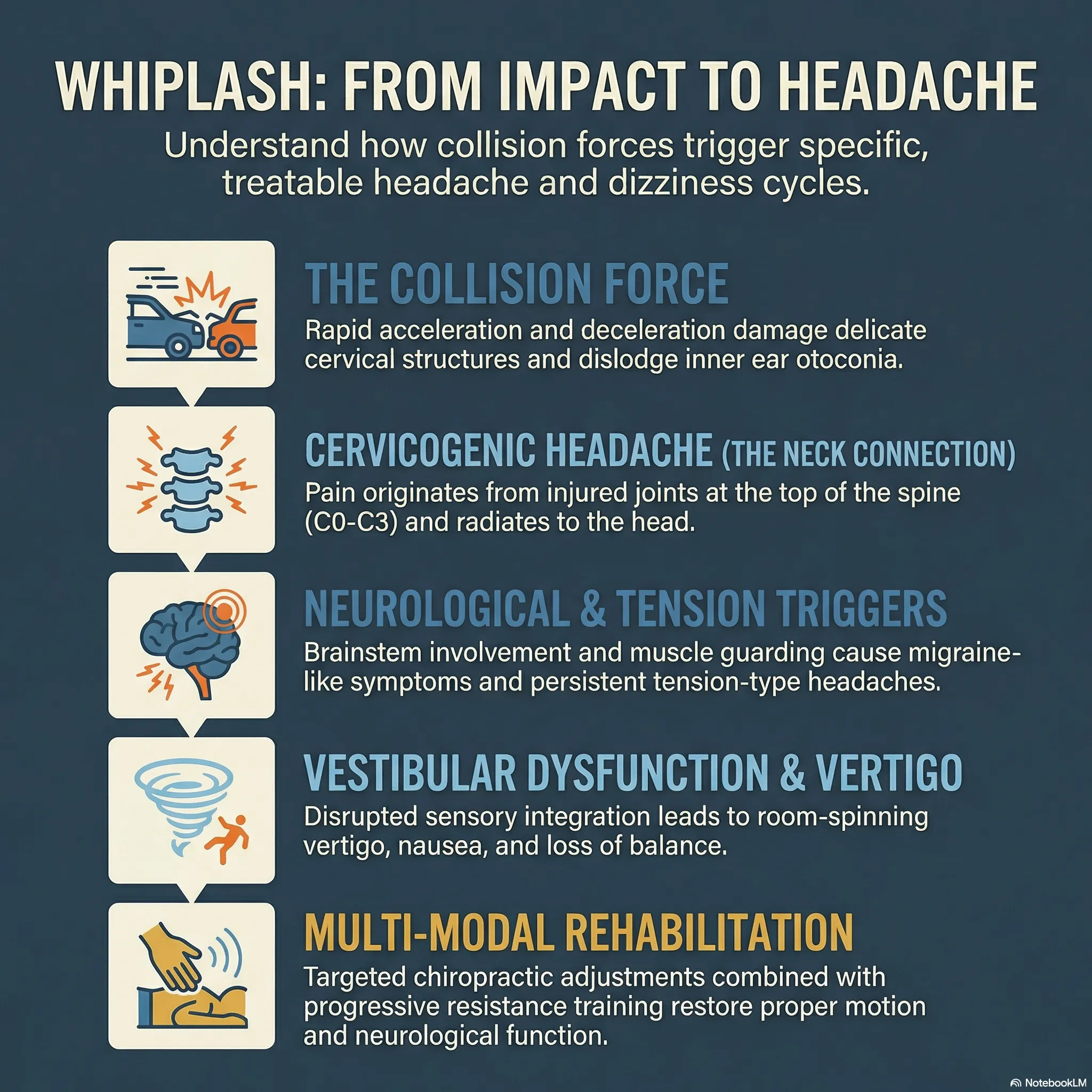
Types of Post-Traumatic Headache
Car accidents produce multiple headache types: cervicogenic headaches originating from injured neck structures — often a whiplash injury — tension-type headaches from sustained muscle guarding, and migraine-like headaches triggered by neurological disruption. Each type requires distinct diagnosis and treatment.
Dizziness & Vestibular Dysfunction
Benign paroxysmal positional vertigo (BPPV) occurs when collision forces dislodge otoconia in the inner ear. Vestibular dysfunction can also arise from cervical proprioceptive disruption or direct concussive injury. Symptoms include room-spinning vertigo, imbalance, and nausea.
Impact on Daily Function
Chronic headaches and dizziness profoundly affect work capacity, driving ability, concentration, and sleep quality. These symptoms can be more functionally disabling than structural injuries, yet they are frequently undertreated and inadequately documented in personal injury cases.
Diagnosis
How we diagnose headaches & dizziness
A systematic evaluation that identifies the origin of symptoms and differentiates between cervical, vestibular, and neurological causes.
Cranial Nerve Examination
A complete cranial nerve assessment evaluates all 12 nerve pairs. This examination identifies subtle neurological findings that suggest concussion, brainstem involvement, or cranial nerve dysfunction. Most providers skip this critical assessment after motor vehicle collisions.
Oculomotor & Vestibular Testing
Smooth pursuit, saccadic eye movement, convergence testing, and the vestibulo-ocular reflex assess both central and peripheral vestibular function. The Dix-Hallpike maneuver identifies BPPV, while head impulse testing evaluates semicircular canal function.
Cervicogenic Headache Screening
Upper cervical flexion-rotation testing, segmental palpation of C0-C3, and reproduction of headache with cervical provocation help identify headaches originating from damaged cervical structures. Cervicogenic headaches are the most treatable post-traumatic headache type.
Balance & Proprioception Assessment
Modified clinical test of sensory interaction in balance (mCTSIB), tandem stance, single-leg balance, and dynamic gait assessment quantify vestibular and proprioceptive deficits. These objective measures document the functional impact of dizziness.
Cervical Spine Evaluation
Detailed assessment of cervical range of motion, segmental joint play, and upper cervical ligament integrity. Cervical instability and upper cervical dysfunction — often stemming from neck pain and cervical spine injury — are frequently the underlying drivers of both headaches and cervicogenic dizziness.
Symptom Pattern Analysis
We carefully characterize headache location, quality, duration, triggers, and associated symptoms. Combined with validated outcome measures for headache disability and dizziness handicap, this analysis differentiates headache types and guides targeted treatment.
Treatment
How we treat headaches & dizziness
A multi-modal rehabilitation program that addresses the cervical, vestibular, and neuromuscular components of post-traumatic headache and dizziness.
Progressive Resistance Training
Deep cervical flexor strengthening and cervicothoracic stabilization exercises address the postural and muscular dysfunction that drives cervicogenic headaches. Progressive loading restores the strength and endurance of muscles that support the head and neck.
Functional Resistance RehabilitationVibration Therapy
Whole-body vibration retrains the vestibular and proprioceptive systems disrupted by collision. Platform-based exercises challenge balance under controlled conditions, progressively restoring the sensory integration necessary for equilibrium and spatial orientation.
Neuromuscular Activation PlatformFocused Shockwave Therapy
Acoustic energy targets the suboccipital musculature, upper trapezius, and cervicothoracic junction where chronic myofascial tension perpetuates headache cycles. Shockwave disrupts pain signaling and promotes tissue healing in these chronically dysfunctional areas.
Advanced Tissue RecoveryChiropractic Adjustments
Upper cervical manipulation and mobilization restore segmental motion at C0-C3, the primary spinal levels that generate cervicogenic headaches and cervicogenic dizziness. Precise manual therapy reduces joint restriction, restores proprioceptive input, and decreases the mechanical triggers of post-traumatic headache. For BPPV, canalith repositioning maneuvers resolve positional vertigo.
- ✓ Upper cervical adjustment (occiput, atlas, axis)
- ✓ Canalith repositioning for BPPV (Epley maneuver)
- ✓ Suboccipital muscle release techniques
- ✓ Vestibular rehabilitation exercises
- ✓ Measurable outcomes documented every visit
Our Difference
What makes us different
Headaches and dizziness require expertise that goes beyond standard chiropractic care. Here is what sets our approach apart.
QME Designation
As a Qualified Medical Evaluator, Dr. Lloyd provides impairment ratings for post-traumatic headache and vestibular dysfunction. His cranial nerve examinations and vestibular assessments produce the objective findings that substantiate these often-subjective complaints.
Defensible Documentation
Cranial nerve findings, vestibular test results, and headache disability scores are documented with clinical precision. Our reports connect specific collision mechanisms to neurological findings, establishing the causal relationship your case demands.
Movement-Based Approach
Headaches and dizziness improve with active rehabilitation, not passive modalities alone. Our progressive approach retrains the cervical, vestibular, and oculomotor systems together, producing functional recovery that medication-based management cannot achieve.
Common Questions
Frequently Asked Questions About Headaches After a Car Accident
What causes headaches after a car accident?
Post-traumatic headaches have multiple causes: cervicogenic headaches originate from damaged neck joints and muscles referring pain upward; post-concussion headaches result from brain injury during impact; tension-type headaches develop from sustained muscle guarding in the neck and shoulders; TMJ disorders can also refer pain to the temples and forehead; and occipital neuralgia occurs when the occipital nerves at the base of the skull are compressed or irritated. Identifying the type determines the treatment approach.
What's the difference between a cervicogenic headache and a concussion headache?
Cervicogenic headaches start in the neck and radiate upward — they worsen with neck movement and can be reproduced by pressing on specific cervical joints. Concussion headaches are more diffuse, often accompanied by cognitive symptoms like brain fog, sensitivity to light and noise, and difficulty concentrating. Dr. Lloyd distinguishes between them using neurological examination and cervical provocation testing, since the treatment differs significantly.
When should I worry about headaches after a car accident?
Seek immediate medical attention if headaches are accompanied by worsening confusion, repeated vomiting, seizures, weakness on one side of the body, slurred speech, or a headache that becomes severely intense within seconds. These can indicate serious intracranial injury. For persistent but non-emergency headaches — especially those that worsen over the first week — an evaluation with Dr. Lloyd is recommended to identify the cause and begin treatment.
How does chiropractic care help headaches after a car accident?
Chiropractic adjustments address cervicogenic headaches by restoring normal mobility to the cervical spine joints, reducing muscle spasm through soft tissue therapy to the suboccipital and upper trapezius muscles, and correcting postural dysfunction that perpetuates headache cycles. For concussion-related headaches, treatment focuses on cervical spine rehabilitation while coordinating with concussion management protocols.
How long do headaches last after a car accident?
Cervicogenic headaches typically improve within 4-8 weeks of chiropractic treatment as the underlying neck injury heals. Post-concussion headaches may persist for 2-3 months, with some patients experiencing prolonged symptoms if not properly managed. Early treatment and accurate diagnosis are the strongest predictors of faster headache resolution.
Get your headaches and dizziness evaluated
Post-traumatic headaches and vestibular symptoms deserve expert assessment. Book your evaluation or call us directly. Same-week appointments available.
Have MedPay on your auto insurance? Learn how to use it here.
Learn more about our car accident chiropractic care in Petaluma.
Conditions We Treat
Other accident injuries
Each condition requires a specific diagnostic and treatment approach. Click to learn how we handle yours.