Condition
Concussion & Mild Traumatic Brain Injury
Often missed in the initial ER visit and frequently co-occurring with whiplash. Concussion requires specialized neurological assessment and careful documentation to support both recovery and your legal case.
Understanding the Injury
What is a Concussion?
A concussion is a mild traumatic brain injury (mTBI) caused by rapid acceleration and deceleration forces acting on the brain during a collision. The brain, suspended in cerebrospinal fluid inside the skull, is subjected to shearing and rotational forces that disrupt normal neural function without necessarily causing visible structural damage on standard imaging.
This is precisely what makes concussion so frequently missed. Emergency rooms focus on ruling out bleeds and fractures using CT scans, which appear normal in the vast majority of concussion cases. The patient is discharged with a clean scan, but the functional neurological injury persists.
Why Concussions Are Missed After Car Accidents
The collision forces that cause whiplash act on the brain simultaneously. When a patient presents with neck pain, the cervical spine injury often dominates the clinical picture while the concussion goes undiagnosed. Adrenaline, shock, and the focus on musculoskeletal complaints can mask neurological symptoms for hours or even days.
Without a thorough cranial nerve examination and cognitive screening performed by a provider who specifically looks for mTBI, concussion can go entirely undocumented, weakening both the patient's recovery and their legal case.
Invisible Injury
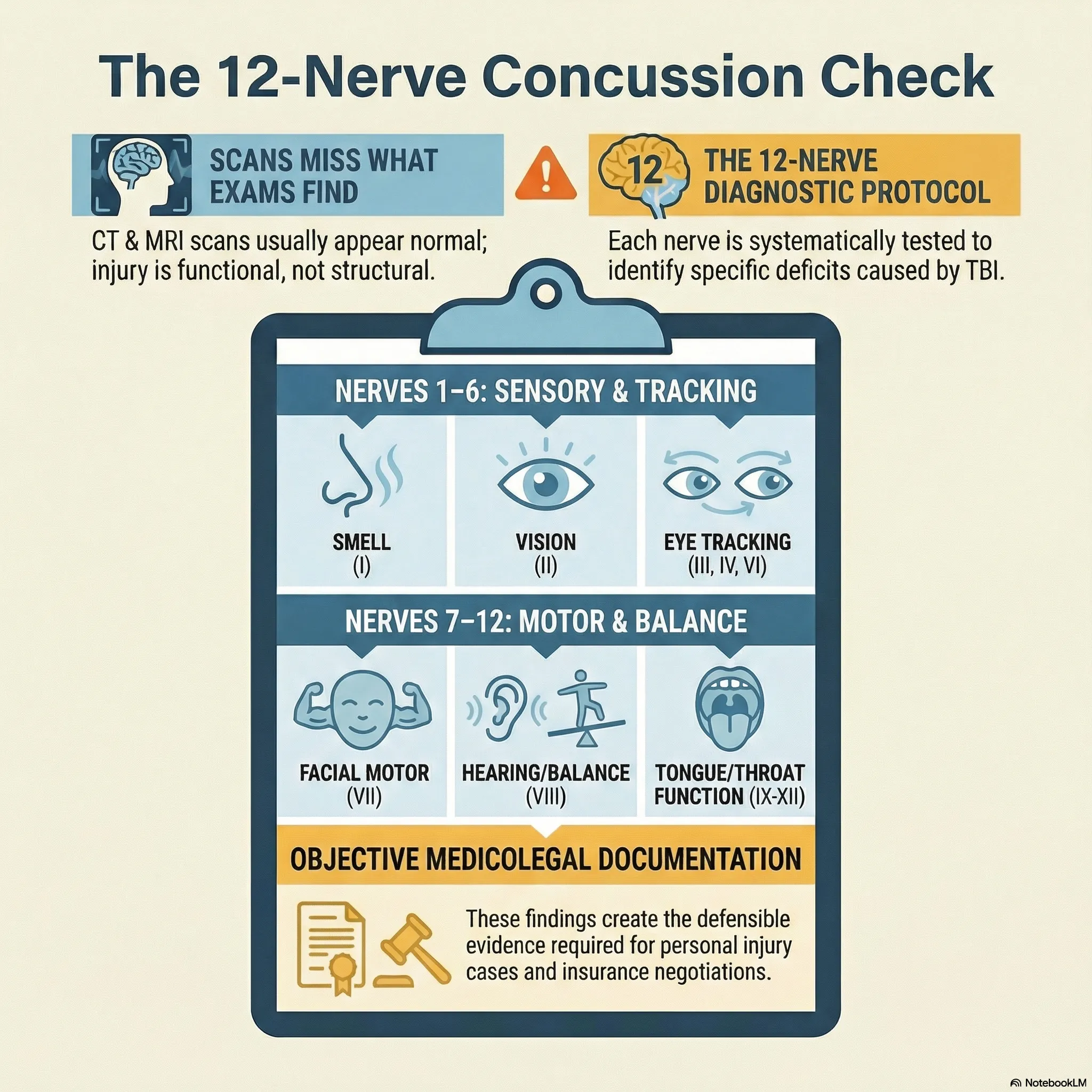
Standard CT and MRI often appear normal after concussion. The injury is functional, not structural, meaning clinical examination is the primary diagnostic tool.
Commonly Missed
ER evaluations focus on life-threatening conditions. Concussion screening requires specific neurological testing that most emergency departments do not perform.
Co-Occurs with Whiplash
The same acceleration-deceleration mechanism that causes whiplash also causes concussion. Every whiplash patient should be screened for mTBI, and vice versa.
Documentation Is Critical
Concussion findings require specific medicolegal documentation to be useful in personal injury cases. Objective cranial nerve findings provide the defensible evidence your case needs.
Recognizing the Signs
Common Concussion Symptoms
Symptoms can appear immediately or develop over hours to days. Many patients don't connect these symptoms to their car accident.
Diagnosis
How We Diagnose Concussion
The cranial nerve examination is the cornerstone of concussion diagnosis. It's the test most providers skip, and it's the test that finds what others miss.
Cranial Nerve Examination
All 12 cranial nerves are systematically evaluated to identify functional deficits caused by the traumatic brain injury.
- Olfactory nerve (CN I) — smell assessment
- Optic nerve (CN II) — visual acuity and fields
- Oculomotor nerves (CN III, IV, VI) — eye tracking
- Trigeminal nerve (CN V) — facial sensation
- Facial nerve (CN VII) — motor assessment
- Vestibulocochlear (CN VIII) — hearing, balance
Vestibular & Balance Assessment
Detailed evaluation of the balance and spatial orientation systems commonly disrupted by concussion.
- Romberg test (static balance)
- Tandem gait assessment
- Dix-Hallpike maneuver for BPPV
- Smooth pursuit and saccade testing
- Vestibulo-ocular reflex assessment
- Dynamic balance on vibration platform
Cognitive & Functional Screening
Standardized assessments to document cognitive and functional deficits with the objectivity required for legal cases.
- Orientation and memory testing
- Concentration and processing speed
- Symptom severity scoring
- Functional capacity evaluation
- Return-to-activity baseline assessment
- Serial reassessment for recovery tracking
Treatment
How We Treat Concussion
Concussion recovery requires a carefully graded approach. We combine vestibular rehabilitation with progressive physical reconditioning, all documented for your case.
Progressive Resistance Training
Graded physical reconditioning that follows concussion recovery protocols. We carefully increase exercise intensity through a graduated exercise protocol to rebuild physical capacity without triggering symptom exacerbation, using heart rate and symptom monitoring.
Graded Exertion ProtocolVibration Therapy
Vestibular and proprioceptive retraining using whole-body vibration. The platform challenges balance systems in a controlled environment, retraining the neuromuscular coordination and spatial awareness disrupted by concussion.
Vestibular RehabilitationFocused Shockwave Therapy
Addresses the cervicogenic component common in concussion patients. Acoustic energy targets myofascial trigger points and chronic tension in the cervical musculature that contribute to persistent post-concussion headaches.
Cervicogenic Headache ReliefChiropractic Adjustments
Targeted cervical adjustments to address the biomechanical dysfunction that co-occurs with concussion. Restoring normal joint mobility reduces cervicogenic headache, improves cervical proprioception, and supports the overall recovery process.
Cervical Joint RestorationObjective Recovery Documentation
Every concussion evaluation and treatment session generates objective, defensible data: cranial nerve findings, balance scores, cognitive screening results, symptom severity ratings, and functional milestones. This creates the measurable recovery timeline that personal injury cases require, from initial injury documentation through maximum medical improvement and permanent impairment assessment.
Medicolegal DocumentationWhy adjust.clinic
What Makes Us Different
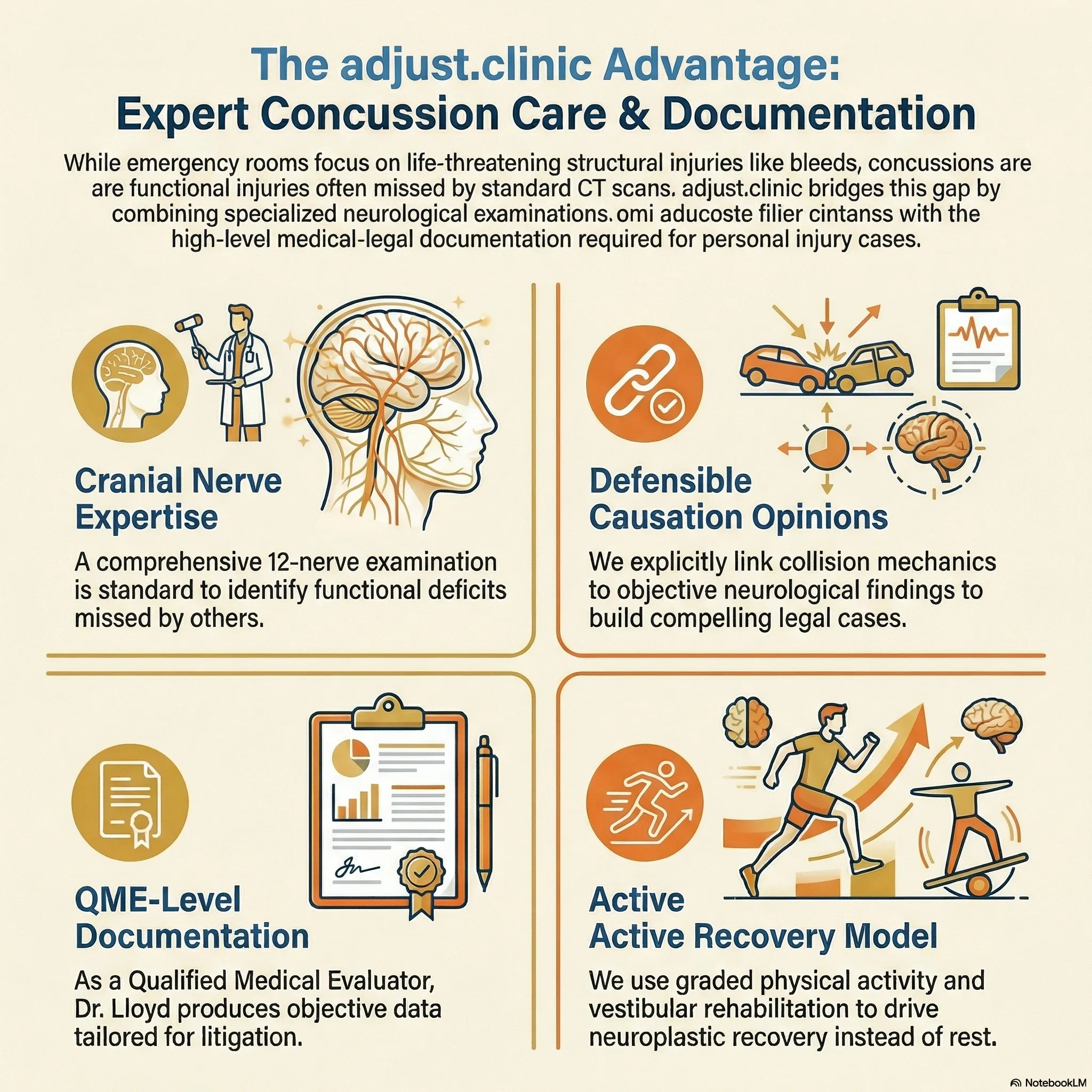
Most providers don't perform cranial nerve examinations after car accidents. We do, on every patient, every time. It's the difference between a documented diagnosis and a missed injury.
-
Cranial Nerve Expertise
A complete 12-nerve cranial examination is standard in every initial evaluation. This is the primary clinical tool for identifying concussion, and the one most providers skip entirely.
-
QME-Level Documentation
As a Qualified Medical Evaluator, Dr. Lloyd produces concussion documentation with the authority and objectivity required for personal injury litigation, insurance negotiations, and courtroom testimony.
-
Defensible Causation Opinions
We connect the dots between the collision mechanism, the neurological findings, and the diagnosis, creating the causation analysis that your personal injury attorney needs to build a compelling case.
-
Active Recovery Model
Current evidence shows that prolonged rest worsens concussion outcomes. We use carefully graded physical activity and vestibular rehabilitation to drive neuroplastic recovery.
Common Questions
Frequently Asked Questions About Concussion
What are the signs of a concussion after a car accident?
Common signs include headache, dizziness, confusion, difficulty concentrating, memory problems, sensitivity to light or noise, nausea, and fatigue. Some symptoms appear immediately while others may not develop for hours or days after the collision. Any head impact or sudden deceleration in a crash warrants evaluation.
Why does Dr. Lloyd perform a cranial nerve examination for concussion?
The cranial nerve exam is the gold standard for detecting subtle neurological deficits that standard concussion screening misses. It evaluates all 12 cranial nerves — testing eye tracking, pupil response, facial sensation, balance, and coordination — to identify specific areas of brain function affected by the injury. This level of detail is critical for both treatment planning and legal documentation.
Can I have a concussion without hitting my head?
Yes. A concussion is caused by rapid acceleration-deceleration of the brain inside the skull. In a car accident, the sudden stop or impact can cause the brain to move forcefully even without direct head contact. This is especially common in rear-end collisions where the head whips forward and backward.
How long does concussion recovery take after a car accident?
Most mild concussions resolve within 2–4 weeks with proper management. However, post-concussion syndrome can persist for months, especially when the initial injury is not properly documented or managed. Early evaluation and structured return-to-activity protocols significantly improve outcomes.
Why is concussion documentation important for my personal injury case?
Insurance companies frequently undervalue or deny concussion claims because symptoms are subjective. A detailed cranial nerve exam, documented cognitive deficits, and objective neurological findings create a defensible medical record that supports your claim and establishes the injury's connection to the accident.
Think you might have a concussion?
Early diagnosis is critical for both your recovery and your case. Book a comprehensive neurological evaluation today.
Have MedPay on your auto insurance? Learn how to use it here.
Learn more about our car accident chiropractic care in Petaluma.
Related Conditions
Other Conditions We Treat
Concussion frequently co-occurs with cervical spine injuries. Explore the other accident-related conditions we specialize in.