Condition
Back Pain After a Car Accident
Collision forces transmit through the entire spine, producing lumbar and thoracic injuries that range from muscle strain to disc herniation and facet syndrome. Thorough evaluation separates simple sprains from injuries that may require long-term management.
Understanding the Injury
What Causes Back Pain After an Accident?
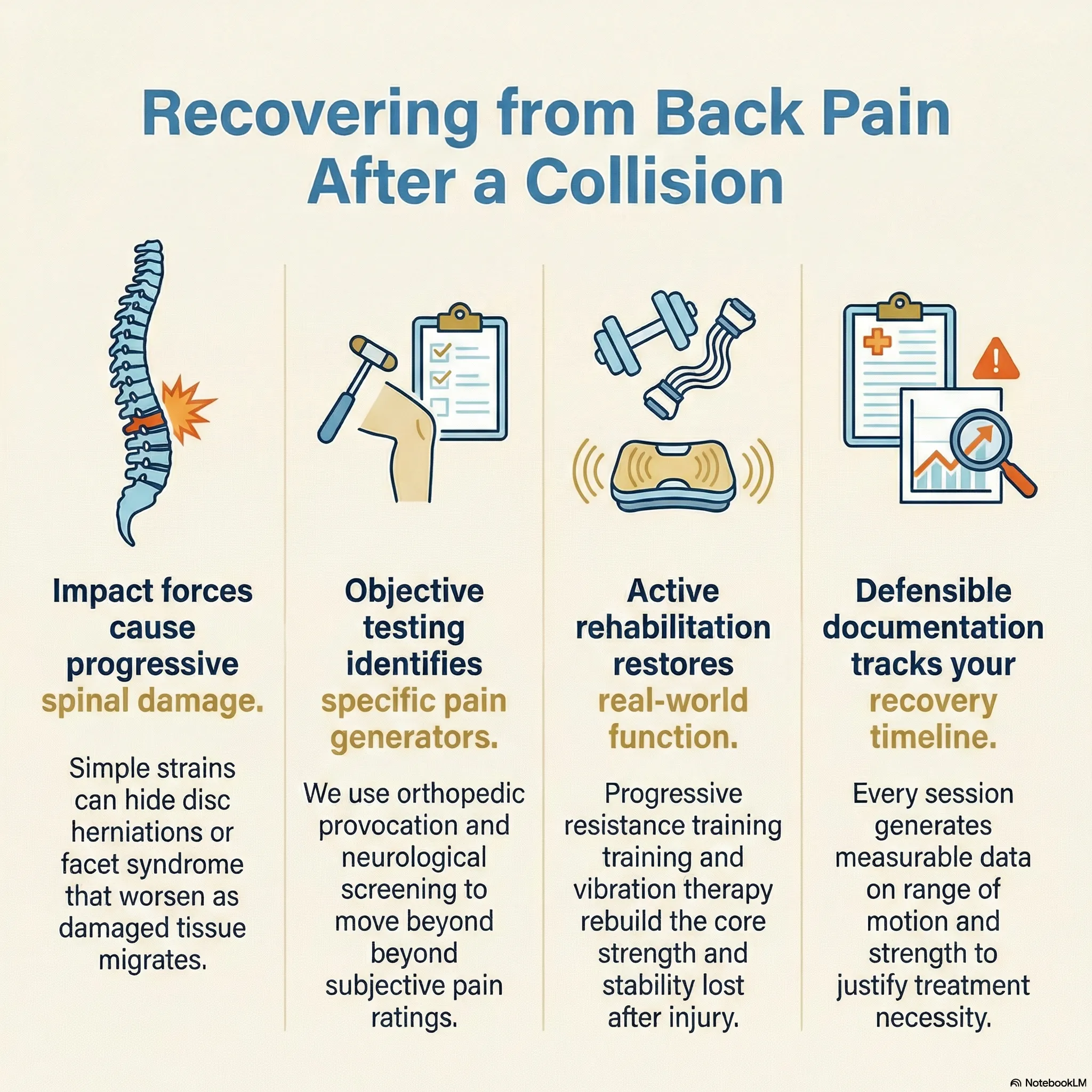
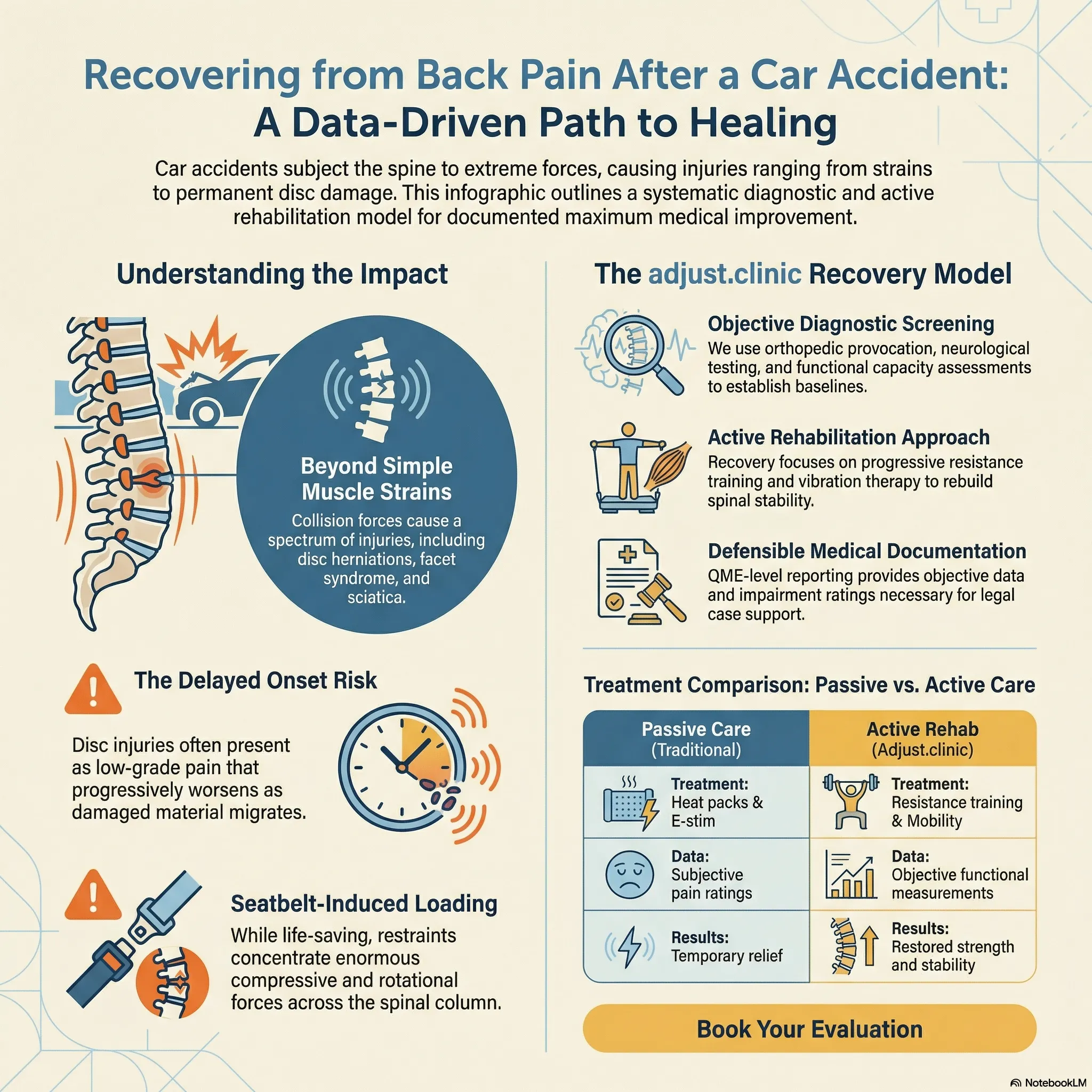
During a car accident, the thoracic and lumbar spine absorb enormous compressive, shearing, and rotational forces. Seatbelt restraint systems, while life-saving, concentrate force across the torso, and the rapid deceleration of impact loads the spinal column beyond its normal capacity. The result can be injury to any combination of muscles, ligaments, discs, facet joints, and neural structures.
The lumbar spine is particularly vulnerable because it bears the greatest load and has the most range of motion in the lower back. Thoracic spine injuries, while less common, can occur in high-speed or side-impact collisions and may involve rib articulations and costovertebral joint injuries in addition to spinal structures. Multi-level collisions frequently produce concurrent neck pain alongside lumbar injuries, requiring evaluation of the entire spinal axis.
The Spectrum of Back Injuries
Back pain after a car accident exists on a spectrum from simple muscular strain to complex disc herniation with sciatica. A strained muscle may heal in weeks with proper rehabilitation. A herniated disc compressing a lumbar nerve root — a condition known as radiculopathy — can cause permanent impairment. Differentiating between these requires a structured clinical examination, not just a pain rating.
Many back injuries also worsen gradually after the initial collision. Disc injuries, in particular, may present initially as low-grade back pain that progressively worsens as the damaged disc material migrates and begins compressing neural structures. This is why ongoing monitoring and reassessment are integral to our treatment approach.
Disc Herniation & Bulging
Compressive forces can rupture or deform the intervertebral disc. Herniated material may impinge on the spinal cord or nerve roots, causing radiating pain into the legs (sciatica), numbness, and weakness.
Facet Syndrome
The lumbar facet joints guide spinal motion and absorb load. Trauma can damage the joint capsules and cartilage, producing localized back pain that worsens with extension, rotation, and prolonged standing.
Muscle Strain & Ligament Sprain
The paraspinal muscles and spinal ligaments can be overstretched or torn during impact. Produces pain, spasm, and functional limitation that may resolve with proper progressive rehabilitation.
Sciatica
Compression of the lumbar nerve roots, typically from a disc herniation, causes radiating pain, numbness, or weakness that travels from the low back through the buttock and down the leg along a specific nerve pathway.
Diagnosis
How We Diagnose Back Pain
A systematic lumbar and thoracic spine evaluation that identifies every injured structure, screens for nerve involvement, and establishes the baseline for your recovery.
Orthopedic Examination
Comprehensive evaluation of the thoracolumbar spine using provocation tests designed to identify the specific pain generators.
- Lumbar range of motion with inclinometry
- Straight leg raise (SLR) for disc herniation
- Kemp's test for facet joint pathology
- SI joint provocation testing
- Paraspinal palpation and spasm assessment
- Thoracolumbar segmental motion testing
Neurological Screening
Lower extremity neurological assessment to identify lumbar nerve root involvement and screen for red flags.
- Lower limb dermatome testing (L1-S1)
- Myotome strength grading (hip, knee, ankle, toe)
- Deep tendon reflexes (patellar, Achilles)
- Sciatic nerve tension testing
- Bowel and bladder function screening
- Upper motor neuron sign assessment
Functional Capacity Assessment
Objective measurement of physical function to establish baseline limitations and track recovery progress.
- Lumbar range of motion (dual inclinometry)
- Trunk strength and endurance testing
- Sit-to-stand functional evaluation
- Lifting capacity assessment
- MRI referral for disc and soft tissue evaluation
- Clinical-imaging correlation documentation
Treatment
How We Treat Back Pain
Progressive rehabilitation that rebuilds the functional capacity your back needs for daily life. Evidence-based treatment documented at every step.
Progressive Resistance Training
Restores core and paraspinal muscle strength critical for spinal stability. Graded resistance exercises target the multifidus, erector spinae, abdominal wall, and gluteal muscles that atrophy after lumbar injury, rebuilding the muscular support system the spine depends on.
Core Stabilization ProtocolVibration Therapy
Reactivates deep lumbar stabilizers and restores proprioceptive control. Whole-body vibration challenges the neuromuscular system to rebuild the automatic stabilization patterns that protect the lumbar spine during movement and loading.
Deep Stabilizer ActivationFocused Shockwave Therapy
Addresses chronic paraspinal muscle tension, myofascial trigger points, and fibrotic tissue that develop after lumbar injury. Acoustic energy penetrates deep tissues to stimulate cellular repair and break up adhesions limiting recovery.
Deep Tissue RecoveryChiropractic Adjustments
Targeted spinal manipulation to restore segmental mobility in fixated lumbar and thoracic joints. Addresses the biomechanical restrictions caused by protective muscle guarding and joint inflammation, creating the mobility foundation for effective rehabilitation.
Spinal Mobility RestorationObjective Progress Documentation
Every treatment session generates measurable data: lumbar range of motion measurements, trunk strength benchmarks, functional capacity scores, pain ratings, and activity tolerance levels. This creates the documented recovery timeline that demonstrates improvement, justifies ongoing treatment necessity, and provides the foundation for impairment ratings at maximum medical improvement.
Defensible Medical RecordsWhy adjust.clinic
What Makes Us Different
Back pain after a car accident deserves more than a generic treatment plan. We identify the specific injury, target the specific structures, and build a documented case for your recovery.
-
QME Designation
Dr. Lloyd's Qualified Medical Evaluator certification provides authority to his diagnoses, impairment ratings, and opinions on causation and treatment necessity. His reports carry independent examiner weight.
-
Functional Capacity Evaluation
We don't just measure pain. We measure what you can do: how far you can bend, how much you can lift, how long you can sit and stand. Objective functional data is the foundation of defensible injury documentation.
-
Active Rehabilitation Model
Passive treatments like heat packs and electrical stimulation don't rebuild function. Our progressive resistance approach restores the strength and endurance your back needs to return to normal activity.
-
Complete Case Documentation
From initial evaluation to maximum medical improvement, every data point is documented: mechanism of injury, clinical findings, imaging correlation, treatment records, outcome measures, and impairment ratings.
Common Questions
Frequently Asked Questions About Back Pain After a Car Accident
How do I know if my back pain after a car accident is serious?
Warning signs of a serious back injury include radiating pain into the legs, numbness or tingling in the feet, difficulty walking or standing, bowel or bladder changes, and pain that worsens over the first few days rather than improving. Any of these symptoms warrant immediate evaluation to rule out disc herniation, fracture, or nerve compression.
When should I get an MRI for back pain after a car accident?
An MRI is indicated when you have radiating leg pain (sciatica), progressive neurological symptoms, or back pain that persists beyond 4-6 weeks of conservative treatment. Dr. Lloyd uses clinical examination findings to determine the right timing for imaging — ordering too early can miss evolving injuries, while waiting too long delays treatment.
Can chiropractic care help a disc injury from a car accident?
Yes. Most disc injuries — including bulges, protrusions, and small herniations — respond well to conservative chiropractic care combined with rehabilitation exercises. Treatment focuses on reducing nerve irritation, restoring spinal mobility, and strengthening the supporting muscles. Surgery is rarely needed and is only considered after conservative care has been exhausted.
How long does back pain last after a car accident?
Lumbar sprains and strains typically improve within 6-10 weeks. Facet joint injuries may take 8-14 weeks. Disc injuries with radiculopathy often require 3-6 months or longer to reach maximum medical improvement. Dr. Lloyd tracks your progress with objective measurements at every visit to document your recovery trajectory.
Will I need to pay for back pain treatment after my car accident?
No upfront cost. Adjust Clinic treats all personal injury patients on a lien basis — you pay nothing until your case settles. We also coordinate MedPay benefits from your auto insurance policy to cover treatment costs immediately, with no out-of-pocket expense to you.
Back pain from your car accident?
A thorough evaluation identifies the specific injury and starts building your case from day one. Same-week appointments available.
Have MedPay on your auto insurance? Learn how to use it here.
Learn more about our car accident chiropractic care in Petaluma.
Related Conditions
Other Conditions We Treat
Back injuries often occur alongside cervical and extremity injuries. Explore the other accident-related conditions we specialize in.