Radiculopathy After a Car Accident
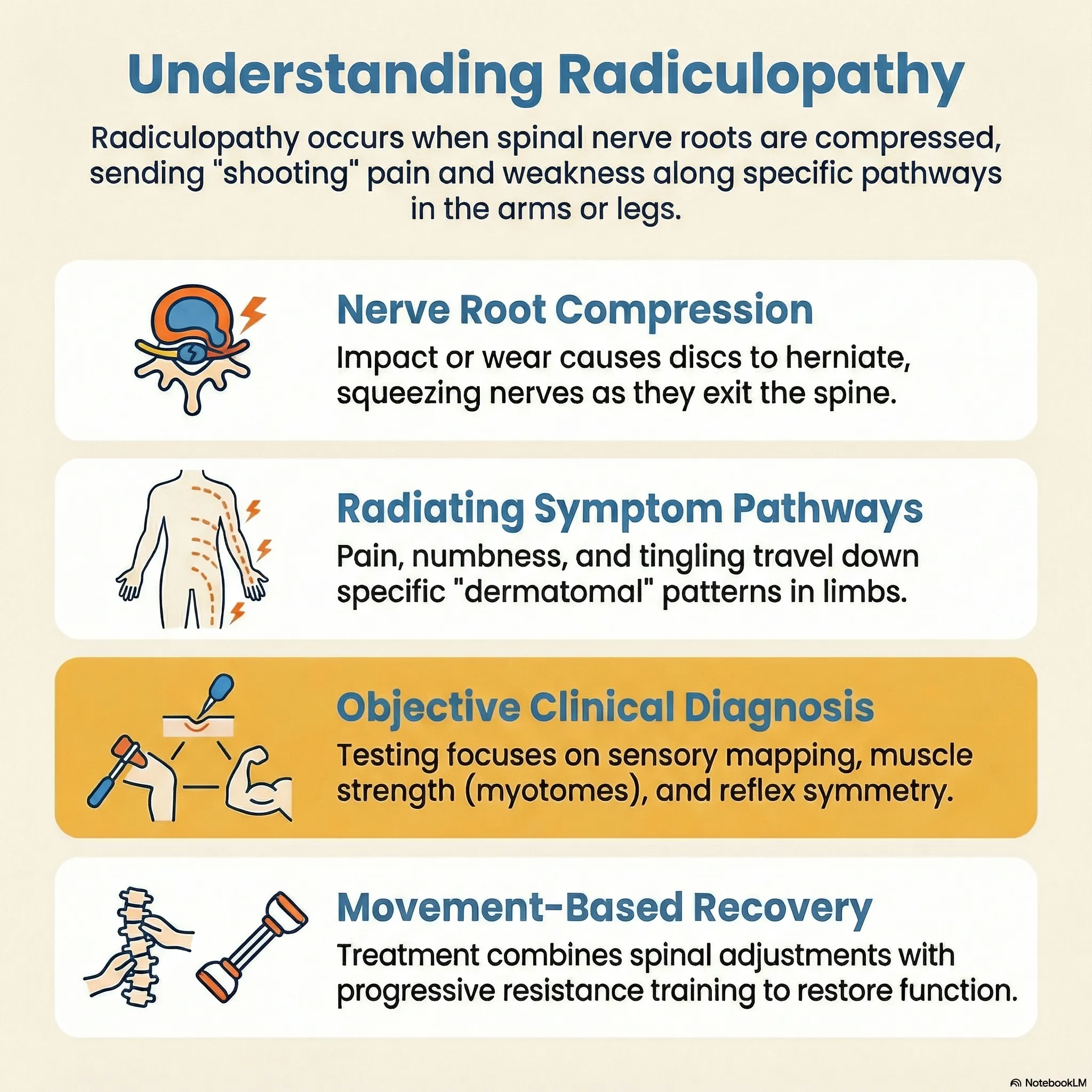
Nerve compression from disc herniation or foraminal narrowing causes radiating pain, numbness, and tingling that travels along specific nerve pathways. After a collision, these injuries demand precise diagnosis and documentation to connect symptoms to the mechanism of injury.
What Happens in a Collision
The force of impact — particularly in whiplash injuries — can herniate intervertebral discs or cause foraminal stenosis, compressing spinal nerve roots as they exit the vertebral column. Even low-speed collisions generate enough force to displace disc material into the neural canal.
How Symptoms Present
Radiculopathy produces radiating pain that follows specific dermatomal patterns. Patients report shooting pain, numbness, tingling, or weakness traveling down the arm (cervical) or leg (lumbar), often worsening with certain positions or movements.
Why It Matters Legally
Radiculopathy produces objective neurological findings including measurable sensory deficits, reflex changes, and motor weakness. These objective findings are critical in personal injury cases because they provide defensible, documentable evidence of nerve injury that personal injury attorneys rely on to build strong claims.
Diagnosis
How we diagnose radiculopathy
Precise identification of the affected nerve root guides treatment and produces the objective findings your case requires.
Dermatomal Mapping
We perform systematic sensory testing along established dermatomal patterns to identify the specific nerve root involved. Light touch, pinprick, and temperature testing reveal the distribution and severity of sensory deficits.
Myotomal Testing
Manual muscle testing of specific myotomes identifies motor weakness corresponding to individual nerve roots. Grip strength, wrist extension, biceps, and triceps testing for cervical radiculopathy associated with cervical pain. Hip flexion, knee extension, and ankle dorsiflexion for lumbar involvement.
Reflex Assessment
Deep tendon reflex testing at biceps (C5), brachioradialis (C6), triceps (C7), patellar (L4), and Achilles (S1) provides objective grading of nerve root function. Asymmetric reflexes strongly suggest radicular involvement.
Provocative Testing
Spurling's test, upper limb tension tests, and straight leg raise are performed to reproduce radicular symptoms and confirm nerve root compression. Positive findings are documented as objective clinical evidence.
Electrophysiological Studies
When clinical findings warrant, we refer for EMG and nerve conduction studies. These tests measure electrical activity in muscles and nerve conduction velocity, providing objective confirmation of nerve root compromise.
Differential Diagnosis
We carefully differentiate radiculopathy from peripheral nerve entrapment syndromes such as carpal tunnel, thoracic outlet syndrome, and cubital tunnel. Accurate diagnosis prevents misattribution and strengthens your clinical and legal position.
Treatment
How we treat radiculopathy
A progressive, multi-modal rehabilitation program that reduces nerve compression, restores function, and documents improvement at every step.
Progressive Resistance Training
Targeted strengthening exercises address muscle weakness caused by nerve compression. We progressively load affected myotomes to restore motor function, stabilize the spine with stabilization exercises, and reduce mechanical stress on compressed nerve roots.
Functional Resistance RehabilitationVibration Therapy
Whole-body vibration activates deep spinal stabilizers and retrains disrupted proprioceptive pathways. For radiculopathy patients, this restores neuromuscular coordination that nerve compression has impaired, improving balance and postural control.
Neuromuscular Activation PlatformFocused Shockwave Therapy
Acoustic energy targets paravertebral tissue adhesions and chronic inflammation around compressed nerve roots. Shockwave promotes tissue remodeling and increases blood flow to areas of nerve compromise, accelerating recovery in resistant cases.
Advanced Tissue RecoveryChiropractic Adjustments
Spinal manipulation and mobilization techniques are carefully applied to restore segmental motion, reduce foraminal compression, and improve the biomechanical environment around compromised nerve roots. Joint restrictions at the level of radiculopathy are addressed to restore normal disc-nerve spatial relationships.
- ✓ Segmental motion restoration at the affected spinal level
- ✓ Foraminal decompression through targeted mobilization
- ✓ Adjacent segment dysfunction correction
- ✓ Flexion-distraction for disc-related radiculopathy
- ✓ Measurable outcomes documented every visit
Our Difference
What makes us different
Radiculopathy cases require precision. Here is how our approach produces better outcomes for your health and your case.
QME Designation
As a Qualified Medical Evaluator, Dr. Lloyd provides impairment ratings and causation opinions that hold weight with insurance adjusters, opposing counsel, and in courtroom settings. His evaluations are conducted to the standards required by the California Division of Workers' Compensation.
Defensible Documentation
Every neurological finding is recorded using standardized grading scales. Dermatomal deficits, myotomal weakness, and reflex asymmetries are documented with specificity that withstands scrutiny from insurance medical examiners and defense experts.
Movement-Based Approach
Passive care alone does not resolve radiculopathy. Our progressive rehabilitation program actively restores function, produces measurable improvement data, and demonstrates medical necessity at every treatment milestone — the combination that resolves your injury and supports your case.
Common Questions
Frequently Asked Questions About Radiculopathy
What is radiculopathy and how is it different from regular back or neck pain?
Radiculopathy occurs when a spinal nerve root is compressed or irritated, typically by a herniated disc or bone spur. Unlike localized back pain or neck pain, radiculopathy causes symptoms that travel along the nerve path — shooting pain, numbness, tingling, or weakness in the arm (cervical) or leg (lumbar). It indicates a more significant structural injury than a simple strain.
What's the difference between cervical and lumbar radiculopathy?
Cervical radiculopathy involves nerve compression in the neck (C-spine), causing pain, numbness, or weakness that radiates into the shoulder, arm, or hand. Lumbar radiculopathy involves the lower back (L-spine), causing sciatica — pain that shoots down the buttock, thigh, and into the foot. The specific nerve root level determines exactly where symptoms appear, which Dr. Lloyd identifies through detailed neurological examination.
Do I need an EMG or nerve conduction study for radiculopathy?
EMG and nerve conduction studies (NCV) are recommended when clinical findings suggest significant nerve damage, when symptoms persist despite treatment, or when objective nerve function data is needed for your personal injury case. These tests measure how well the nerves are conducting electrical signals and can pinpoint the exact level and severity of nerve involvement.
Can radiculopathy from a car accident be treated without surgery?
Yes — the majority of radiculopathy cases respond to conservative care. Treatment at adjust.clinic includes spinal adjustments to reduce nerve irritation, targeted rehabilitation exercises to stabilize the affected segment, and shockwave therapy for chronic cases. Surgery is only considered when conservative care fails after an adequate trial or when progressive neurological deficits require urgent intervention.
Can I get an impairment rating for radiculopathy from a car accident?
Yes. Radiculopathy with documented nerve root involvement often qualifies for impairment ratings under the AMA Guides using the DRE (Diagnosis-Related Estimates) method. Objective findings from your neurological exam, MRI, and EMG/NCV studies support the rating. Dr. Lloyd provides these ratings as part of your personal injury documentation.
Get your radiculopathy evaluated
Nerve compression requires prompt, expert diagnosis. Book your initial evaluation or call us directly. Same-week appointments available.
Have MedPay on your auto insurance? Learn how to use it here.
Learn more about our car accident chiropractic care in Petaluma.
Conditions We Treat
Other accident injuries
Each condition requires a specific diagnostic and treatment approach. Click to learn how we handle yours.