Chest & Rib Injuries After a Car Accident
Costochondral separations, intercostal strains, and sternal contusions from seatbelt loading and impact forces produce breathing-related pain that disrupts sleep, limits physical activity, and is often far more disabling than it initially appears. These injuries are frequently missed on standard imaging.
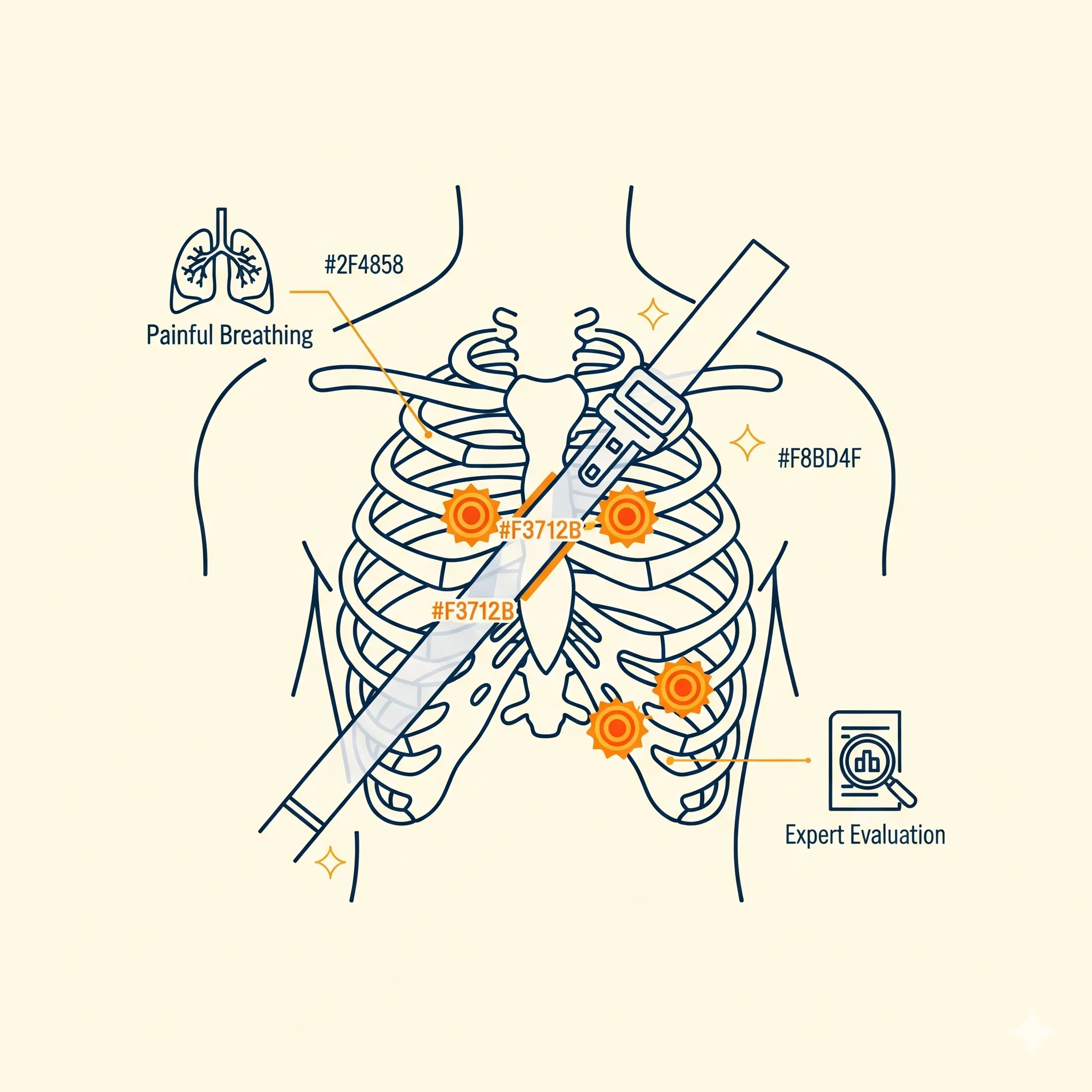
How Seatbelts Cause Injury
The seatbelt that saves your life can also injure your chest wall. During a collision, the lap-shoulder belt transmits tremendous deceleration force across the sternum, clavicle, and rib cage. This loading pattern produces contusions, costochondral separations, and sternal fractures that are characteristic of motor vehicle trauma — often occurring alongside whiplash from the same collision forces.
Breathing-Related Pain
Chest and rib injuries make every breath painful. Deep inspiration, coughing, sneezing, and laughing all stress the injured structures. Patients instinctively adopt shallow breathing patterns that reduce oxygen intake, impair sleep quality, and can lead to secondary respiratory complications.
Often Missed on Imaging
Standard X-rays frequently fail to show costochondral separations, cartilage injuries, and non-displaced rib fractures. Patients are told their imaging is normal despite experiencing significant pain. This imaging gap leads to undertreated injuries and inadequately documented personal injury claims.
Diagnosis
How we diagnose chest & rib injuries
Clinical examination identifies injuries that imaging misses. We document the specific structures involved and the functional impact on your daily life.
Rib Palpation & Spring Testing
Systematic palpation of each rib from the costovertebral junction to the sternum identifies point tenderness and crepitus. Rib spring testing applies controlled anteroposterior pressure to detect costochondral separation and intercostal instability that X-rays cannot visualize.
Respiratory Function Assessment
We assess chest expansion during respiration by measuring circumferential excursion at inspiration versus expiration. Asymmetric expansion, splinting patterns, and reduced tidal volume are documented as objective evidence of chest wall dysfunction.
Costochondral Junction Exam
Specific testing of each costochondral and costosternal junction identifies separation injuries where cartilage meets bone. These injuries produce localized point tenderness with palpable step-off deformities that are pathognomonic for costochondral disruption.
Intercostal Muscle Testing
Provocation testing through resisted trunk rotation, lateral flexion, and deep breathing isolates intercostal muscle strain from rib fracture and costochondral injury. The pattern of pain reproduction during specific movements identifies the involved structures.
Thoracic Spine Evaluation
The thoracic spine and rib articulations function as an integrated unit. We assess costovertebral and costotransverse joint mobility, thoracic segmental motion, and associated paraspinal muscle guarding that accompanies chest wall injury.
Functional Impact Documentation
We document the impact of chest wall injury on sleep position, breathing capacity, lifting tolerance, and work tasks. Activities of daily living affected by pain with respiration are recorded using validated outcome measures to quantify disability.
Treatment
How we treat chest & rib injuries
A progressive rehabilitation program that restores chest wall function, normalizes breathing mechanics, and returns you to daily activities.
Progressive Resistance Training
Graduated trunk and respiratory muscle strengthening restores the chest wall's ability to withstand normal loading. Exercises progress from isometric stabilization to dynamic resistance, rebuilding the intercostal, serratus, and thoracic paraspinal muscles injured by collision forces.
Functional Resistance RehabilitationVibration Therapy
Whole-body vibration activates deep trunk stabilizers and thoracic postural muscles. Platform-based exercises retrain the neuromuscular coordination of the chest wall during upright activity, restoring the stability needed for pain-free breathing and functional movement.
Neuromuscular Activation PlatformFocused Shockwave Therapy
Acoustic energy targeted at costochondral junctions, intercostal muscles, and periosteal attachment points accelerates tissue healing in areas of chronic inflammation. Shockwave is particularly effective for costochondral injuries that resist standard conservative care.
Advanced Tissue RecoveryChiropractic Adjustments
Manual therapy addresses the costovertebral, costotransverse, and thoracic spine joint restrictions that accompany chest wall injury. Restoring normal rib articulation mechanics reduces splinting, improves chest expansion, and normalizes breathing patterns. Specific rib mobilization techniques restore the normal bucket-handle and pump-handle rib motion essential for comfortable respiration.
- ✓ Costovertebral joint mobilization
- ✓ Thoracic spine segmental adjustment
- ✓ Rib articulation restoration techniques
- ✓ Respiratory muscle release and retraining
- ✓ Measurable outcomes documented every visit
Our Difference
What makes us different
Chest and rib injuries are dismissed as minor because they look normal on X-ray. We know better, and we document accordingly.
QME Designation
As a Qualified Medical Evaluator, Dr. Lloyd provides impairment ratings for chest wall injuries using AMA Guides criteria. His clinical expertise identifies and documents injuries that standard imaging misses, providing the medical evidence your case needs.
Defensible Documentation
Point-specific palpation findings, chest expansion measurements, and respiratory function assessments are documented with precision. Our reports establish that normal X-rays do not mean normal function, and connect seatbelt loading patterns to specific chest wall injuries.
Movement-Based Approach
Chest wall injuries heal through progressive, controlled loading, not immobilization. Our rehabilitation program restores breathing mechanics, trunk stability, and functional capacity through evidence-based exercise progressions that produce measurable improvement at every stage.
Common Questions
Frequently Asked Questions About Chest and Rib Pain After a Car Accident
What causes chest and rib pain after a car accident?
The most common cause is seatbelt loading — the diagonal shoulder belt concentrates impact force across the chest wall, bruising or fracturing ribs and straining the costochondral joints where ribs connect to the sternum. Airbag deployment adds another mechanism, delivering blunt force to the chest. Thoracic spine injuries from the collision can also refer pain to the chest wall.
How do I know if I have a rib fracture or costochondritis?
Rib fractures produce sharp, localized pain that worsens with deep breathing, coughing, or pressing directly on the injured rib. Costochondritis — inflammation of the rib-sternum joints — causes pain at the front of the chest that may mimic cardiac symptoms. Dr. Lloyd differentiates between them through physical examination, palpation, and diagnostic imaging when needed. Both injuries are well-documented in car accident cases.
Can a chiropractor treat rib injuries from a car accident?
Yes. Chiropractic treatment for rib and chest wall injuries includes thoracic spine adjustments to restore mobility, soft tissue therapy to reduce intercostal muscle spasm, and breathing rehabilitation exercises. For rib subluxations — ribs that have shifted slightly out of position — gentle manipulation can restore normal rib mechanics and significantly reduce pain.
How long does it take for rib injuries to heal after a car accident?
Rib contusions typically heal in 3-4 weeks. Costochondritis may take 4-8 weeks to resolve. Rib fractures generally heal in 6-8 weeks, though pain can persist longer. Thoracic spine injuries that accompany rib trauma may require 8-12 weeks of chiropractic care. Dr. Lloyd monitors your recovery with objective pain and mobility measurements at each visit.
Should I go to the ER or a chiropractor for chest pain after a car accident?
If you experience severe chest pain, difficulty breathing, or symptoms that could indicate cardiac or pulmonary injury, go to the emergency room first. Once life-threatening conditions are ruled out, chiropractic evaluation is appropriate for ongoing chest wall pain, rib dysfunction, and thoracic spine injuries. Many patients are discharged from the ER with "chest wall contusion" and benefit significantly from follow-up chiropractic care.
Get your chest and rib injuries evaluated
Chest wall pain after an accident needs expert assessment. Book your initial evaluation or call us directly. Same-week appointments available.
Have MedPay on your auto insurance? Learn how to use it here.
Learn more about our car accident chiropractic care in Petaluma.
Conditions We Treat
Other accident injuries
Each condition requires a specific diagnostic and treatment approach. Click to learn how we handle yours.